Friday, December 30, 2022

Joseph (Joe) F. SHANLEY (1940-2022)

Hilarie's uncle Joseph (Joe) SHANLEY passed away on Christmas eve 2022, and the memorial service was held on Thursday (yesterday) December 29th. The funeral was held at St Patrick's Olyphant (where Joe had been baptized in 1940 on the same date as the funeral), and the burial took place at the St Patrick's Cemetery (off Route 6).


Joseph F. Shanley
Obituary published by Scranton Times from Dec. 27 to Dec. 28, 2022.

JOSEPH SHANLEY OBITUARY
Joseph F. Shanley, 82, of Olyphant, died unexpectedly on Sunday, at home.

Born in Olyphant, he was the son of the late Francis and Gertrude Kelly Shanley, and he was a member of Holy Cross Parish at St. Patrick's Church, Olyphant. He was a 1958 graduate of St. Patrick's High School. He served with the U.S. Army stationed in Monmouth, N.J., and Japan, and he was a member of the American Legion Raymond Henry Post 327, Olyphant. He had been employed by Tobyhanna Army Depot, and he retired from General Dynamics. He owned and operated Shanley's Bar in Jessup.

Joe appeared to be a no-nonsense kind of guy but inside he was much softer. He had a fierce loyalty to what he believed in and to his people. To know him was to love him and he was a great friend. He worked hard his whole life. In addition to his full-time job, he always had a weekend job going from doing roofing with his twin brother or later cutting trees.

Surviving are three children, Leigh Runco, and husband, Frank, Olyphant; Joseph Shanley, Olyphant; and Tiffany Shanley, Jessup; a granddaughter, Chelsea Strelecki, and husband, Steve, Archbald; a brother, James Shanley, and wife, Diane, Dickson City; sisters, Jeanne Van Nort, Olyphant; and Mary Boretsky, Dickson City; his former wife, Paula Shanley; nieces and nephews.

He was preceded in death by brothers, William and Francis J. Shanley; and a sister, Ann Shanley.

A Mass of Christian Burial will be offered on Thursday at 10 a.m. in St. Patrick's Church, 200 Delaware Ave., Olyphant. Friends may call Thursday morning from 9 to 10 a.m. at the church. Interment will follow at St. Patrick's Cemetery, Blakely.

Arrangements are by the Frank T. Mazur Funeral Home, Inc., 601 Dundaff St., Dickson City. For directions or to leave an online condolence visit the funeral home website.

------

In line with his military service, his coffin was draped in an American flag, and there was a grave-side volley of 12 rifle shots. The flag was presented by the flag party to his brother James (my father-in-law).


Friday, June 24, 2022

Death of Harry Wasilchak (1894-1929), updated

 This is an update of the original blog post (https://upanddownthevalley.blogspot.com/2010/11/death-of-harry-wasilchak-1894-1929.html ) with some extra articles I've found.

Harry Wasilchak was ran a dairy in Jessup, PA. I have seen a milk bottle with his name on it. Each bottle had a cardboard stopper placed on the lid - this is the Wasilchak dairy lid:


There is one newspaper article I've found that mentions Harry Wasilchak's dairy. The dairy was located behind the family home on Hand Street in Jessup: 


The Scranton Republican 14 July 1928 › Page 13

JESSUP, July 13. After being missing for eighteen days during which time police from every town In the Mid - Valley searched for him. Alfred Keller, aged 13, of Throop, was found early this morning in the Jessup Dairy stables, owned by Harry Wasilchak. Young Keller was sleeping and obviously on the verge of exhaustion when Policeman,. - John Keller, of Throop, discovered him, He was returned to his parents. Keller formerly lived here and It is believed he was going to visit relatives. -


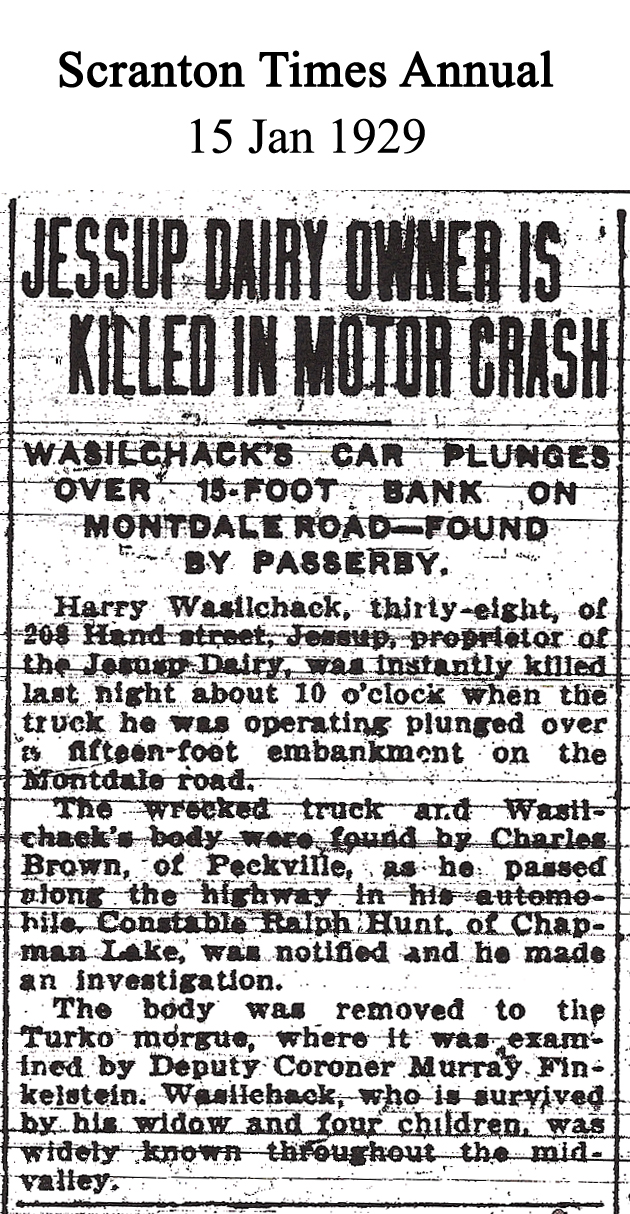
While details are scarce, Harry died at the age of 38 when his truck crashed:


Scranton Times Annual
15 Jan 1929
JESSUP DAIRY OWNER IS KILLED IN MOTOR CRASH
"WASILCHAK'S CAR PLUNGES OVER 15-FOOT BANK ON MONTDALE ROAD - FOUND BY PASSERBY
Harry Wasilchak, thirty-eight, of 208 Hand-street, Jessup, proprietor of the Jessup Dairy, was instantly killed last night about 10 o'clock when the truck he was operating plunged over a fifteen foot embankment on the Montdale Road.
The wrecked truck and Wasilchak's body were found by Charles Brown, of Peckville, as he passed along the highway in his automobile. Constable Ralph Hunt, of Chapman Lake, was notified and he made an investigation.
The body was removed to the Turko morgue, where it was examined by Deputy Coroner Murray Finkelstein. Wasilchak, who is survived by his widow, and four children was widely known throughout the mid-valley."


The funeral of Harry Wasilchak was also reported in the paper:

The Scranton Republican 18 January 1929 › Page 5
JESSUP, Jan. 17. A fine tribute to the memory of Harry Wasilchak, Hand street dairyman, who met death in an accident on the Montdale road, was paid this morning, when hundreds of people were in attendance at his funeral. Members of Hose company, No. 2, of which Mr. Wasilchok was a prominent member, kept a constant vigil throughout the morning. At 9:30 o'clock a high mass of requiem was celebrated in the Holy Ghost Greek Catholic church. Rev. Theodore Lodomersky officiating. Rev. Lodomersky also delivered a fitting eulogy on the deceased. Interment was in the Holy Ghost cemetery. The casket was carried by the following members of Hose company. No. 2 : Joseph Podrasky, Joseph Sobolcskie, "Chic" Simler, Andrew Smolko, Michael Cholish, and Joseph Maceyko. Over a score cf firemen were required to carry the numerous floral wreaths.

Sunday, April 3, 2022

Obituary for Daniel Grabin (1921-2005)

My wife Hilarie SHANLEY wrote this obituary for her grandfather Daniel Grabin. At the time it was published in the Scranton Times Tribune, but this text ensures his obituary is now available on-line. This blog has a separate transcribed history of the 33rd Troop Carrier Squadron, and a separate post with newspaper article describing the car he built.


Daniel Grabin, 84, of Dickson City, died early Sunday at home. His wife of 64 years is the former Martha Wasilchak.
 
Born in Peckville, son of the late Stephen and Anna Grabin, he attended school in Archbald. He began working as a mechanic at Grabin Oldsmobile of Olyphant, which was owned by his father. He was the head mechanic, responsible for the repair and service of automobiles throughout the Midvalley.

He was a proud soldier in the Army Air Corps, 33rd Troop Carrier Squadron. During World War II, he worked as a crew chief in the Pacific theater. He repaired and flew in the planes that took men, munitions and material where they were needed. He fought overseas for three years, during which time he earned nine battle stars and saw duty in Australia, New Guinea, Morotai, Biak, the Philippines, Okinawa and Japan. He was one of the first 50 soldiers into Japan in the final days of World War II, an achievement of which he was extremely proud. Segments from the letters he wrote home were published in a local newspaper. He retained an active interest in the great history that he had been a part of, saving his medals, photographs and B-4 bomber bag.

When he returned home, he worked with Grabin Oldsmobile to bring an automobile to every local veteran who had lost a limb in battle. Always interested in a challenge, he then decided to build his own custom sports car from scratch. Using the old, rusty shell of a 1942 automobile, he rebuilt it piece by piece, adding customizations that would not be seen in automobiles for decades. The finished product was featured in the newspaper and was a source of wonder for anyone who saw it.

He opened his own garage, Grabin's, in 1973. It was there that he would work for the rest of his life. He made a real friend out of each person who met and knew him. Often he would have the companionship of any number of his friends at the garage. He was a kind, ethical businessman, always opting to give his customers a break at the sacrifice of his own pocket.

He was a constant source of knowledge, an avid reader and he enjoyed all types of debate. He was a mechanic in every sense of the word: He had a true, intuitive grasp on the inner workings of everything. He lived for his family, working hard to provide the best opportunities for the people he loved most.
He was a beloved and wonderful husband, father and grandfather.

He is survived by his wife, Martha; two daughters, Sandra Bianca and Diane Shanley and husband, James, all of Dickson City; a granddaughter, Hilarie Shanley, Boston; a brother, John, Eynon; several nieces and nephews.

He was also preceded in death by two brothers, Joseph and Stephen Jr.

The funeral will be held Friday from the James M. Margotta Funeral Home, 1019 Main Street Peckville, with Mass at 9:30 a.m. in Holy Ghost Church, Olyphant, to be celebrated by the Rev. Phillip Sladika, pastor. Entombment, St. Mary's Visitation Mausoleum, Dickson City.

Friends may call Thursday, 4 to 8 p.m.

{Written by Hilarie SHANLEY}

Saturday, December 26, 2020

Legion of Merit citation for Stephen Grabin


Stephen Grabin is known in the family as a war hero. I've previously posted a short article (https://upanddownthevalley.blogspot.com/2009/08/stephen-grabin.html ) about him - he arrived in Australia in Feb/March 1942, and served as an aircraft mechanic (grease monkey) in the US Army Air Corps.

U.S. World War II Army Enlistment Records, 1938-1946
Name: Stephen R Grabin
Birth Year: 1923
Race: White, citizen (White)
Native State or Country: Pennsylvania
State of Residence: Alaska
Enlistment Date: 7 May 1941
Enlistment State: Pennsylvania
Enlistment City: Wilkes Barre
Branch: Air Corps
Branch Code: Air Corps
Grade: Private
Component: Regular Army (including Officers, Nurses, Warrant Officers, and Enlisted Men)
Education: 4 years of high school
Civil Occupation: Semiskilled mechanics and repairmen, motor vehicles
Marital Status: Single, without dependents
Height: 68
Weight: 145


Sunday, March 3, 2019

Jones to Howells to Shanley - and Wales to Olyphant via Nanticoke

The Shanley family uncovered a written family history about the HOWELLS and SHANLEY family. While it isn't dated or signed, it was written by Mary WALBUSH nee SHANLEY (who appears on page 2) and was likely written in the late 1970s. Excitingly, it mentions the Welsh heritage of the family back into the 1850s - which I haven't previously been able to find, given the lack of birth/marriage/death registrations before around 1905 in Olyphant/Lackawanna/Luzerne counties in Pennsylvania.

The letter is likely highly reliable, and possibly includes information extracted from a family bible given the birth/marriage/death dates cited.


Transcript:

Page 1

Evan R Jones of North Wales and Jane Thomas of Llandillo, South Wales were united in marriage June 17th 1858. Jane Thomas was a sister to the Thomas Bro of the firm T Thomas and Sons, Tanners, Bootmakers and Woolstaplers of Llandillo and Carmarthen, S. Wales.

The first child to bless this union was a daughter, Sara Jane. She was born in Mountainash, Glamorganshire, S. Wales, May 6, 1859.

In 1861 they came to America at the beginning of the Civil War. Jane was less than 2 years old when they arrived in America. She married very young to David Howells.

They had 2 children, girls, and at the birth of the 3rd child both mother and child passed away. The girls names were Olwen and Maggie Jane.

Page 2

1. Olwen Howells married Ceradoc Rees, they lived in Nanticoke, Pennsylvania.

    Children
Jane - married Arthur Harris - 1 child - Rees Harris
Ceradoc - single, died at age early 20s 
Ann - single
Ralph - single - Professor at Bucknell U.
Willard - died when a young child

2. Maggie Jane married Frank Shanley and they lived in Olyphant Pennsylvania. 

    Children
Nellie - single, born May 26 1896 died Mar 18 1967
Elizabeth - single, B Nov 20 1899
William - died in infancy
Francis - married Gertrude Kelly He was born Feb 10 1902, died Jan 2 1954
Margaret - single
Joseph (there were two Josephs) - died in infancy
Joseph - single - Born Oct 30 1907 Died Sep 4 1976
Mary - married George Walbush - Born July 22 1910
Olwen - married Edward Hayes - Born Oct 15 1912
Catherine - married Francis Brennan - B Nov 28 1916 D Jun 7 1952
Ann - stillborn

Page 3

1. Francis Shanley and Gertrude Kelly
    Children
Jean Marie - marred Frank Van Nort
Ann - single
Frank - married Jane Weller
Margaret Mary - married Pete Boretsky
William - married Jacqueline Mackell
Joseph - married Paula Baumgartner
James - married Diane Grabin

2. Olwen Shanley - Edward Hayes
    1 child Mary Hayes married James Harbottle

3. Catherine Shanley - Francis Brennan
    1 child - James Brennan married Mildred Naglak

Take it from here


Images


Saturday, July 22, 2017

Frank (Francis) SHANLEY (1938-2017)

Hilarie's uncle Frank (Francis) SHANLEY passed away two few weeks ago, and the memorial service was held on the weekend.

I have some material on Frank to add here.


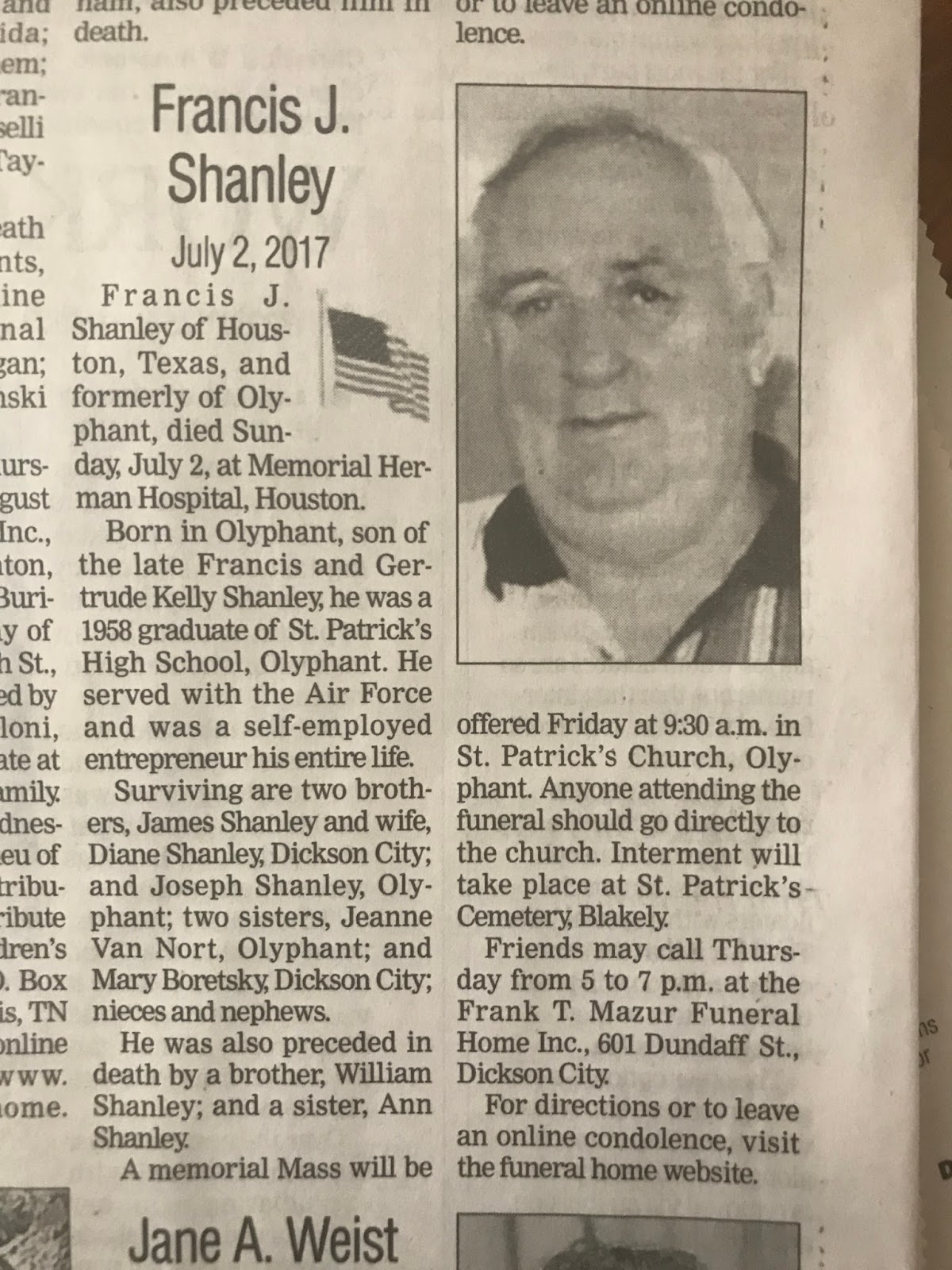
Scranton Times, July 2017
Francis J. Shanley
July 2, 2017
Francis J. Shanley of Houston, Texas, and formerly of Olyphant, died Sunday, July 2, at Memorial Herman Hospital, Houston.
Born in Olyphant, son of the late Francis and Gertrude Kelly Shanley, he was a 1958 graduate of St. Patrick's High School, Olyphant. He served with the Air Force and was a self-employed entrepreneur his entire life.
Surviving are two brothers, James Shanley and his wife, Diane Shanley, Dickson City; and Joseph Shanley, Olyphant; two sisters, Jeanne Van Nort, Olyphant; and Mary Boretsky, Dickson City; nieces and nephews.
He was also preceded in death by a brother, William Shanley; and a sister, Ann Shanley.
A memorial Mass will be offered Friday at 9:30 a.m. in St. Patrick's Church, Olyphant.


At the memorial Mass, Frank's sister Mary Boretsky read the eulogy, which is slightly edited here:

Big Uncle Frank. That's what we all called him. He was always larger than life. Not only in his physical size but in his dynamic personality. He was so much fun to be around. He seemed to know something about everything. He had such a quick wit and could make you laugh for hours. When he would come home from Texas everyone was happy to gather to be with him.
He was very intelligent and was successful at just about everything he ever tried to do. When he was young he was a very good basketball player, and something of a pool shark. He always told me that he made all his spending money playing pool. He was inclined to always find the mischief in every situation. He was part of a Dynamic Duo with his good friend John Kilker. He could always find someone to share his adventures.
He also had a serious side. He and his friend, Joe Nixon, served 6:30 Mass every morning Monday through Friday for the 4 years he was in high school. He spent 4 years in the Air Force. That included a 1 year tour at King Salmon, Alaska. He played basketball with the base's team because they got to fly all around the area and it was a good diversion on a base where you could never even go outside.
He worked in business and lived in Philadelphia and Syracuse. When he got a chance to move to Texas he was very happy to do so. He spent most of his life there and considered it home. He went on to be successful in business and to eventually run his own company.
When he started his business he bought a house to live in and to run the business from. He had always had a Doberman Pinscher and he bought a Miniature Dachshund (Fritz). He was a cute little dog who literally never left his side. I asked him why he would buy a little dog like that and he said, very matter of factly, that is was the size of the doggy door in the house. He was nothing but practical.
He was the third Frank Shanley. He used to tell me that he probably would not live to be 52. And if he did he would be the first Frank Shanley who ever did.
He loved cars and was drawn to convertibles. Mostly he would have a Corvette. Somehow that suited him fine. He loved children and they loved him.
I feel like this is biographical. So I want to say that he was our brother and we all loved him very much. He was the kind of person we will not forget.
My sister Jeanne found a nice piece I would like to read:
'We are the rememberers, the people left behind to keep the one who's gone from us alive in heart and mind-the people left to cherish and preserve a legacy.'
Yes, we are the rememberers, and we will always be. As long as we live, we will share who you were.

------------

At the wake, there were several photo boards with photos of Frank:


Sunday, November 27, 2016

Frank Van Nort (1931-2016)

Frank Van Nort
August 9, 1931  -  November 22 2016
(married Jeanne Shanley abt 1955)

Scranton Times Obituary
25 November 2016


Frank J. Van Nort, 85, of Olyphant, died Tuesday at home. His wife is the former Jeanne Shanley. The couple had been married for 61 years.

Born in Carbondale, son of the late Frances Flederbach and Frank Van Nort, he was a graduate of Archbald High School and was a member of Holy Cross Parish, Olyphant. A machine operator and programmer at Lockhead Martin for most of his life, Frank was a talented handyman, fixing and building anything asked of him.

He enjoyed bowling, golfing, hunting, fishing and was very proud to have served his country. Frank was a veteran of the Air Force, serving in Japan during the Korean War.

Also surviving are his children, Joseph Van Nort, Jeanne Van Nort Kropa and husband, William; a sister, Loretta Brennan; two grandchildren, Corrinne and Shayna Kropa; and several nieces and nephews.

He was also preceded in death by a brother, William Van Nort; and three sisters, Frances Kerzic, Mary Dilts and Rita Kulikowski.

The funeral will be Saturday at 9 a.m. from the Hudak-O'Shea Funeral Home, 115 Garfield Ave., Olyphant, with Mass of Christian Burial at 9:30 in Holy Cross Parish at St. Patrick's Church, 200 Delaware Ave., Olyphant, to be officiated by Monsignor Delaney. Burial will follow in the parish cemetery. Military services will be held by American Legion Raymond Henry Post 327 Olyphant and the Air Force.


---------

The Olyphant branch of the Legion had this sign up on Saturday of the funeral, regarding the military service.


----------

I will update this post with a photo of the headstone at the St Patrick's cemetery, Blakely PA, in the future.

UPDATE July 2017: headstone installed:


Wednesday, October 12, 2016

Dunmore Cemetery visit

This weekend we visited the beautiful Dunmore Cemetery in Scranton, Northeast Pennsylvania. The cemetery contains many beautiful monuments among modest headstones, and contains the graves and mausolea of many families who played a significant role in the development of the area, including namesake families (http://www.nepanewsletter.com/towns.html). For example....

In the foreground of this general view of the cemetery is the Dickson family mausoleum, after who Dickson City was named (https://en.wikipedia.org/wiki/Thomas_Dickson_(industrialist) ).

Large marker stone for the FINLEY family plot. The fernleaf motif represents sorrow, and was relatively common in the cemetery.

The mausoleum of Frederick J Platt, beautiful art deco architecture. Platt was a descendant of an early influential family, was involved in Scranton corporate life, and published a book on the early history of Scranton in 1948 (https://archive.org/details/earlyhistoryofsc00plat ).

 This was the only ZINC headstone I observed in the cemetery (http://granite-in-my-blood.blogspot.com/2009/01/zinc-gravestone.html ) - and the first I've ever seen. The monument is in stunning condition (a benefit of using zinc, which is extremely stable). This grave belongs to Mary Jane Roesler, born Feb 3, 1820, died Apr 23, 1885. Note that the right-hand panel can be unscrewed for installation of a new monumental inscription.

This is the BOIES family mausoleum, dug into the side of a steep hill. Likely the family of Col. Henry M. Boies (http://thetimes-tribune.com/news/150-who-made-scranton-great-henry-m-boies-1.1981772 ), a colonel and civil war veteran who was a businessman and inventor.

The ZIMMER family pyramid (?), very unique. Marks the graves of John & Theresa Zimmer : Sept 5, 1856 - July 4 1912, and Jan 24 1867 - July 4 1912. Note that both died on the same date - independence day 1912. Would be very interested to learn the story of this couple.
EDIT: Thanks to Kyle Brimacombe for solving this: John & Theresa Zimmer were killed in a grueling train wreck in Corning, NY on 4 July 1912 (https://en.wikipedia.org/wiki/Corning_train_wreck).

 Obelisk-topped monument, monument somewhat eroded, to John Dekin(?) died 1878, a native of Deptford, England. Topped with a masonic symbol.

Grave of George W. Scranton (https://en.wikipedia.org/wiki/George_W._Scranton), with a long tribute engraved on the monument.

 Grave topped with statue pointing to the heavens. Grave of John S. Gillespie, born 4 Nov 1844, died Apr 12 1932, and Maggie, died Aug 10 1879 aged 28 years 8 months and 24 days. 

Very unusual grave marker for the GRIFFIN  family, stone carved into faux logs and branches.

Angel atop grave marker. Grave of DUCKWORTH family.

 MOLOWNEY grave with Celtic cross.

Delightful font on this HILL family plot marker (HiLL). 

Mourning statue atop large grave monument for EVERHART family.

Both sides of a PLATT family Celtic cross, stating within crucifix at top 'My Faith Looks Up To Thee'. This one connects the above PLATT and SCRANTON family. 
Front (clean): JOSEPH CURTIS PLATT Born Saybrook Conn. Sept. 17 1816 Died Scranton PA Nov 15 1887. CATHARINE S. SCRANTON HIS WIFE Born Madison, Conn. Apr 1 1822 Died Scranton PA July 4 1887.
Back (dark): JOSEPH CURTIS PLATT Jr. Born Fair Haven Conn. Jan 9 1845, Died Waterbury NY July 7 1898. KATHARINE J. JONES HIS WIFE, Born Penn ?? NY Apr 28 1846, Died Waterford NY May 28 1934(?).

Saturday, January 25, 2014

Ann Shanley (1934 - 2014)


Ann Shanley, 79, of Olyphant, died Thursday evening January 23, 2014 at Regional Hospital of Scranton.

Born in Olyphant, she was the daughter of the late Francis and Gertrude Kelly Shanley and she was a member of Holy Cross Parish at St. Patrick’s Church, Olyphant. She attended St. Patrick’s Parochial School, Olyphant.

Ann was a loving and caring sister and aunt who was very loyal to her family. She will be deeply missed by everyone who knew her.

Surviving are two sisters, Jeanne VanNort and husband, Frank, Olyphant, Mary Boretsky, Dickson City; three brothers, Francis Shanley, Houston, TX, Joseph Shanley, Olyphant and James Shanley and wife, Diane, Dickson City; nieces and nephews.

She was preceded in death by a brother, William Shanley.

The funeral will be Tuesday at 9 a.m. from the Frank T. Mazur Funeral Home, Inc. 601 Dundaff St., Dickson City, with mass at 9:30 a.m. in St. Patrick’s Church, Olyphant. Interment Mt. Carmel Cemetery, Dunmore.

Friends may call Monday 5 to 8 p.m. For directions or to leave an online condolence visit www.mazurfuneralhome.com.


 These two images of Ann ('Nanny') provided by Kelly Boretsky.

Saturday, January 4, 2014

A great find - Mary KELLY/MULLINS to O'BRIEN marriage, Duryea 1920

My last post was on William Kelly, murdered in 1911 in a saloon in Duryea. As I mentioned, his widow Mary married a man named O'Brian/O'Brien between 1920 and 1930 and he subsequently died prior to 1930 - so in the 1920 census she was Mary Kelly, widow, and in 1930 she was Mary O'Brien, widow! In both she was living at 135 Foote Ave, Duryea.

So who was this O'Brien, married and died within a decade? Thankfully after much searching around, Familysearch has a page dedicated to records available for Luzerne county, PA, in which Duryea is located (https://familysearch.org/learn/wiki/en/Luzerne_County,_Pennsylvania). By searching the marriage records for Luzerne county scanned into Familysearch I uncovered the following marriage. Not only does it answer who this O'Brien was, but Mary KELLY nee MULLIN states her parents names - the Shanley family story is that she was sent to the US by her family as a young girl after losing the family goat, and so this may be one of the only documents listing her parents names:


No. 91491
James O'Brien, born in Pittson PA, Age 37, Color white, Residing in Pittston Pa.
Occupation Laborer, not married before. Not related by blood or marriage to the person he desires to marry. Not afflicted with any transmissable disease.
Name of father John, of mother Mary, maiden name Coyne.
Residence of father desceased, residence of mother deceased.
Birthplace of father Pittston Pa, birthplace of mother Pittston, Pa.

Mary Kelly, born in Ireland, Age 38, Color white, Residing in Duryea Pa.
Occupation Housekeeper. Was married before death Aug 4, 1911. Not afflicted with any transmissable disease.
Name of father Patrick Mullen, of mother Cecelia, maiden name Grady.
Residence of father deceased, residence of mother deceased.
Birthplace of father Ireland, birthplace of mother Ireland.
Marriage license issued 24 Dec 1920
Married 29 Dec 1920 by Rev. C.A. Staib, Duryea Pa.

 So Mary the widower married James later in the census year of 1920 - at the census he was living with two sisters on Main St in Pittston. By 1930 James was dead. A search of newspapers.com showed that he died almost ten years later, in 1930 immediately prior to the next census:
 

The Scranton Republican
11 January 1930
James O'Brien Taken By Death in Duryea
DURYEA, Jan 10. James O'Brien, well known resident of this borough, died this morning in his home, York avenue, after an illness of two weeks. He was a communicant of Sacred Heart Catholic church. Surviving are his widow; two daughters, Mrs. James Donlin and Gertrude O'Brien; two sons, George and William O'Brien, and two sisters, Mrs. Edward Grady and Mrs. Michael Stration.

Wednesday, April 17, 2013

The Death of William Kelly (1878-1911)

The family story is that William KELLY was a big man, who didn't lose fights. The story as related to me goes that "Pa death cert
1911
Kelly, William , 74181, duryea, aug 4

Wilkes-barre record almanac
1912 WB Record Almanac, Deaths in 1911
Kelly, William, 29, duryea, aug 4
."

It has taken me several years to finally track down his death.

William Kelly was born about 1878 in Luzerne county, PA. In the 1880 census he is listed living in 'Pleasant Valley' with his parents Thomas and Ann (both born in Ireland), and an older brother Thomas and a younger brother George. In the 1900 census William was still living at home at Duryea, his 50 year old mother now a widow, and younger siblings John and Frances had arrived after 1880. The three eldest boys were all coal miners.

Around 1903 (but I can't find the record), William married Mary MULLIN. According to family stories, she came from Ireland when she was 13 years old, sent away by the family for losing the goat she was responsible for looking after.

Birth records are unavailable for this period, so we look to the 1910 records. On Foot Avenue, Duryea, in side-by-side homes live Willam's widowed mother Ann and her unmarried children. In the second home lives William Kelly and his wife Mary, married for 8 years. Mary stated she immigrated to America in 1885 (not found) and in a later census stated she naturalized around 1902 (not found). William and Mary had three children in 1910: Anna (4), George (2) and Gertie (less than 1).

And sure enough, in 1920 Mary Kelley (sic) is now living on York Ave in Duryea, widowed and with and extra child born after 1910: Anna (13), George (12), Gertrude (11) and William (8). Mary worked as a servant, her employer a 'private family'.

So when did William Kelly die? Well, if William was born around 1912 it was presumably after that point. And that was my mistake. Recently PA put death indexes on-line at www.portal.state.pa.us/portal/server.pt/community/public_records/20686


From these after much searching (one must read through pdf files - no search engine):

Pa death cert
1911
Kelly, William , 74181, duryea, aug 4


This was confirmed in a transcript of the Wilkes-Barre record almanac
1912 WB Record Almanac, Deaths in 1911
Kelly, William, 29, duryea, aug 4


So William died BEFORE his son William was born. Lesson learnt. Once I had this information, Joe Bryer and the good people at the Genealogical Research Society of Northeast Pennsylvania (GRSNP - http://www.grsnp.org) looked into newspapers for that date and forwarded me a report of William's death.

Scranton Republican
August 4, 1911
DURYEA MAN DEAD AS RESULT OF BEATING
Blood-Clot on Brain Caused by Beating Results in Death
PITTSTON, Pa., Aug. 4 - William Kelly, a young man residing in Duryea, died this morning about 11 o'clock and his death adds another homicide trial to Luzerne county's list. The circumstances surrounding the death of young Kelly are similar to those of the death of Peter Sterling, who was fatally injured during a fight.
According to the story obtained by the police of Duryea, Kelly had a fight two weeks ago with John Slatisky, of Duryea, in front of Nalley's saloon on Donnelly street. The men came to blows and Slatisky is said to have hit Kelly on the head with terrific force. Shortly after the fight, Kelly went home and a doctor was summoned. It was found there was a blood clot on the brain, and a few days later paralysis set in, death following today. Kelly was about twenty-eigh years of age, and well known in the town. Slatisky has been arrested and given a hearing before Squire Gilboy, who held him for court.

So the family story was essentially intact 100 years on. The next step will be to track down the outcome of the court case.

As an afternote, Mary married a man named O'Brian/O'Brien between 1920 and 1930 and he subsequently died - so in the 1930 census  Mary Obrien was still living at 135 Foote Ave, widowed and living with two of her children. Apparently Mary opened a bar in her house to support the family, and it was in this bar that her daughter Gertrude met her future husband Frank Shanley.

EDIT: I received a second article with some follow-up, but I still don't know what the outcome of the trial was.

Scranton Republican
9 Aug 1911
DURYEA SUSPECT ASKS TO BE FREED FROM JAIL
Man Accused of Killing William Kelly Seeks Liberty
Special to the Tribune Republican
WILKES-BARRA, Pa. Aug 8 - Claiming that he is unjustly held in the Luzerne county jail, charged with the murder of William Kelly, of Duryea, George Slatky, of the same place, through his attorney, E.C. Jones, made application to the court this morning for a writ of habeus corpus. Judge Jones, before whom the petition was presented, agreed to give the man a hearing Friday at 11 o'clock.
Kelly died the last part of last week from injuries he received in a fight in Duryea. Slatky was arrested charged with the crime and, after a hearing, sent to the prison, where he was to be held to await the action of the grand jury.


FURTHER EDIT:
Searching at newspapers.com I found some information on the sentencing of Slatky, from thePittston Gazette, 2 Dec 1911, stating that Slatky was sentenced to two years jail for manslaughter. Another article from the trial indicates that Slatky worked at the bar where Kelly was assaulted.


Monday, April 2, 2012

History of the 33rd Troop Carrier Squadron


Daniel Grabin (1921-2005) served during World War Two in the 33rd Troop Carrier Squadron, Army Air Corps. He enlisted at Wilkes Barre on the 5th August, 1942 at Wilkes Barre, PA - a few miles down the valley from his home town of Eynon. He was single on enlistment, but must have married very shortly afterwards, because he left for war married to Martha WASILCHAK. Daniel worked as a crew chief in the Pacific theatre. He returned home to the valley to have two children and run a successful business.

The 33rd Troop Carrier Squadron (http://en.wikipedia.org/wiki/33d_Troop_Carrier_Squadron) does not have a published unit history. However, Bob Monson, a member of the 33rd, has over many years maintained connections between members of the 33rd and distributed regular Newsletters. Bob provided me with a copy of a short typewritten history compiled for those receiving the newsletter (by whom I am not sure) and have transcribed it here, with his permission.


HISTORY
33RD TROOP CARRIER SQUADRON
(Condensed From Unit Histories, February 1942 – November 1945)

On 17 February 1942, he 33rd Transport Squadron was activated at Middletown Air Depot, Pennsylvania and became a unit of the 315th Transport Group. The original cadre was selected from the 2nd Transport Squadron, with First Lieutenant Elmer F. Estrumse, from the 6th Transport Squadron, in command. Shortly after activation, the squadron began to operate with C-39s, loaned by the 2nd Transport Squadron, hauling cargo from Middletown to widely scattered points in the United States as well as Newfoundland, Haiti, Cuba and other foreign air fields. The squadron’s first plane, a C-53, was assigned during the first week of June 1942.

On 17 June 1942, the squadron changes its station to Bowman Field, Ky. An influx of personnel increased the organization from cadre to approximately half its T/O strength. The organization continued to haul cargo to diverse points while at Bowman Field, and in addition, instituted an extensive training program for both flying and ground personnel.

On 3 August 1942, the squadron moved from Bowman Field, Ky. To the Army Air Base, Florence, South Carolina. The movement was completed on 5 August. The squadron began to gather its required strength of pilots and enlisted men as combat crews, it allotted quota of aircraft. An intensive overseas training program was immediately undertaken. Flying personnel engaged in night flying and dropped paratroops in southern maneuvers. Ground personnel were given infantry and commando training. While at Florence, the number of aircraft in the unit was raised to a maximum of thirteen. The squadron sustained its first loss of personnel when Sergeant Joseph Archembault died on 29 August 1942, at Florence S.C., as a result of injuries received in a motor vehicle accident.

On September 1942, seventy-two officers and enlisted men formed an air echelon and departed for Hamilton Field, Calif., for overseas transition training. Two weeks later, on 20 October 1942, the ground echelon departed Florence, S.C. by rail, arriving at its destination, Pittsburg, Calif. On 27 October 1942.

On 18 October 1942, the air echelon, under the command of Captain Eugene R. Jackson, departed Hamilton Field with thirteen planes for the Southwest Pacific. Upon arrival at Canton Island, the evening of 21 October 1942, ten planes and crews assisted in the search for Captain Eddie Rickenbacker and his companions for two days.

The air echelon arrived at New Caledonia 25 October 1942. Seven of the squadron’s planes and crews were delayed there until 29 November 1942 to ferry personnel and supplies to Guadalcanal and New Hebrides Islands, using Tontuta as a base. Wounded personnel were returned from Guadalcanal. Here the squadron sustained its first casualties in the Southwest Pacific Area. On 8 November 1942, a C-47 with S/Sgt Ray V. Hensman at the controls, was seen to burst into flame after takoff, as it passed over the northerly end of Henderson Field, Guadalcanal, then in the hands of the Japanese. It had been struck by enemy ground fire. Two weeks later, 22 November 1942, another plane was totally demolished in a take-off crash at New Hebrides with a load of hand grenades. The crew was seriously injured but there were no fatalities. On 29 November 1942, then five remaining planes departed Tontuta, joining the rest of the air echelon at Ward’s Drome, Port Moresby, N.G. on 2 December 1942.

The remaining six planes continued on to Brisbane, Qld., thence to Cairns, Qld., and operated from there and New Guinea until 10 December 1942 when they were sent to their permanent station in New Guinea. On the first of November these six planes began to operate from Port Moresby in support of the Papuan and Buna.

The ground echelon departed the Golden Gate early on the morning of 3 November 1942 aboard the USS Tjisdane ; arrived Auckland, New Zealand on 22 November where it remained for four days, arriving at Brisbane, Australia on 1 December. Billeted at Camp Doomben, three weeks elapsed during which training was continued (hikes, drill, weapons instructions, etc.) The squadron embarked on the supply ship “Isaac Coles” on 21 December. There were no troop facilities on board, and the men slept in one of the holds on strips of plywood laid on the floor. Strict smoking orders were enforced since there were thousands of tons of live ammunition, torpedoes, and bombs on board. After a seven day strenuous trip, Port Moresby, New Guinea, was reached on 28 December 1942. The meeting of the air and ground echelons was a never-to-be-forgotten moment. The ground echelon was informed that although an area had been assigned, no camp had been established. The air echelon had slept in the planes, eating cold “C” Rations or eating occasionally at Camp Arcadia whose small kitchen appeared to be the only one on the island.

The men immediately set up tents and prepared sites for permanent quarters to be put up as soon as the pyramidal tents would be unloaded from the boat.

The unit was notified that it had become a part of the newly designated 374th Troop Carrier Group, pursuant to General Order No. 32, Hq. 5th Air Force, 12 November 1942, which was being built up in Brisbane.

During this month, two of the six aircraft, with crews, were list. Nine enlisted men had been killed and one officer and two enlisted men were missing. One was the result of an attack by Japanese Zeros, while the other crashed in the Owen Stanley Range. Of the latter, on 10 November 1942, a plane loaded with 20 Australia infantry troops crashed near Dobodura, New Guinea. Second Lieutenant George W. Vandervort and Sgt. Steven J. Pitch were killed, while Sgt. George R. Kershner, radio operator, was miraculously spared. Sgt. Kershner wandered through the New Guinea jungles for 38 days before he was rescued. Remains of Sgt. Pitch and nine infantry men were recovered in July 1944.[1]

During the month of January 1943, the war was brought to the men in the form of air raids. These raids resulted in little damage but they did manage to keep the men up most of the night.

During these early months, a dispute arose as to who was Commanding Officer of the squadron. Captain Eugene R. Jackson had been placed in command of the air echelon at Hamilton Field by order of the I Troop Carrier Command at Indianapolis, Indiana. At about the same time, Captain Robert L. Ward was assigned to the squadron at Florence, S.C. and placed in command by order of Lt. Col. Hamish McLelland, Commanding Officer of the 315th Troop Carrier Group. The issue was settled by Colonel Paul H. Prentiss, Commanding Officer, 374th Troop Carrier Group. His decision placed Captain Ward in command. His tenure of office was short due to the early promotion of Captain Jackson to Major.

The air echelon had welcomed the arrival of the ground echelon for they had been flying daily, without rest, since their departure from the States. Now they would be able to get more rest because of the crew members who had come over with the ground echelon. Their exuberance was short lived for the battle for the Wau strip was in progress and all the unit’s planes were busy flying in Australian troops until the Japanese were eventually driven out in February.

It was during the height of this battle that another of our planes was lost to enemy action.[2] On 7 February 1943, several flights of planes reached the Wau strip simultaneously with 20 Japanese bombers and several fighters. The bombers dropped their loads on the strip and the fighters took after our aircraft. All escaped except the plane piloted by Lt. Robert H. Schwensen. The plane was last seen with two Zeros on its tail. Coincident with the Wau battle, the 33rd planes were required to carry supplies to Kokoda, Dobodura, Buna and dropping missions on the various battle fronts in Papua inaccessible to air strips. Casualties were usually evacuated on the return trips from the strips. The planes, upon approaching Ward’s Drome, would fly a distinctive colored streamer, indicating wounded aboard, and would be met immediately upon landing by American and Australian ambulances.

For its vital part in the Papuan Campaign, between 19 September 1942 and 22 December 1942, the 374th Troop Carrier Group was cited in par. III, War Department General Order No. 3, 15 January 1943. Also included in citation, WD Co. #21, 6 May 1943.

Operations were separated from Engineering in January and Lt. Cartwright was appointed Operations Officer. Communications were also established as a separate unit under the direction of Lt. Richard Krolik.

The 33rd continued to fly unprecedented numbers of troops and tons of supplies to Dobodura and Wau and Bulolo, where the enemy were being gradually pushed back into Salamau and Lae. To the Allied troops on the front lines of this sector, daily dropping missions kept them in supplies and ammunition.

Enemy activity over the Port Moresby area was being gradually reduced to hit and run night raids of one, two and occasionally three planes. Day raids were a thing of the past so personnel had become lax in the upkeep of their slit trenches. This proved to be unfortunate when at 1000 hours on 12 April 1943 forty odd Japanese bombers and sixty-five Zeros raided Seven Mile Strip and Ward’s Drome. Personnel on the strip crowded into several culverts. The 33rd suffered no damage to installations or equipment.

In July 1943, squadrons of the 375th Troop Carrier Group arrived. The 56th and 58th Squadrons were attached to the 33rd for rations, quarters and flying. These squadrons flew operational missions with the 374th Group and under the guidance of the group’s old pilots built up experience and knowledge necessary for safe flying over the Owen Stanley Range and the SWPA in general. At the end of the month the 375th Group departed Moresby and moved to Dobodura.

Ground and air operations against Lae and Salamua increased in tempo until the early weeks in September when Lae capitulated on the 16th. The Group’s planes were soon hauling equipment and personnel on a regular shuttle between Moresby and Lae.

In October 1943, the entire Group moved to Australia. Headquarters and the 6th, 22nd and 33rd Squadrons went to Townsville and the 21st Squadron to Brisbane. The 33rd made a complete exchange of equipment with the 41st Troop Carrier Squadron, 317th Troop Carrier Group at Townsville. They in turn moved into our area at Moresby, taking over the equipment left by the 33rd. Although still under the administrative control of the 5th Air Force, the Group was placed under the operational control of the Directorate of Air Transport.

A heavy schedule of operations was undertaken by the Group, and men and equipment were moved in a steady flow to all parts of Australia, especially Darwin and other West Australian military establishments. Another shuttle schedule was made between Morseby and Townsville. To the Group also fell the task of ferrying personnel from Moresby to the rest area at Mackay, Qld. Flights from Townsville were altogether different than those from Moresby. All were at least four hours long. Here we would take a load to one station, off load, reload and head on flying until darkness or weather forced an RON.

While stationed in Townsville, the number of aircraft assigned to the Squadron was increased.  This enabled us to step up production. Air miles flown and flying hours were almost doubled. This change came without any increase in personnel. Gradually, however, new men were added and manpower problems were overcome. During the period from October 1943 to April 1944, the squadron learned to maintain and operate twice as many aircraft as ever before, and during this period, only one major accident occurred over the Coral Sea probably as the result of bad weather.

On 14 April 1944, the 33rd Troop Carrier Squadron movement from Townsville to Port Moresby began and was completed on 16 April, except for heavy vehicles and equipment scheduled to come by boat. April 20th the organization moved from temporary billets at Hq. 5th Air Force to the permanent base at the old 5th Troop Carrier Wing area. Camp construction was started immediately. Diligent and cooperative work resulted in one of the best camp area in New Guinea. Major Wamsley was appointed Base Commander of Ward’s Airdrome effective 17 April 1944.

The middle of May 1944, squadron operations, intelligence, and engineering moved from Ward’s to Jackson Drome. The move involved hauling several buildings approximately a mile and a half. At Ward’s Drome the Intelligence Department had ample space on the second floor of the Base Operations Building. At Jackson, the space allocated by DAT was so insufficient that it required building. New materials being unavailable for construction, salvage from the old 6th and 33rd Troop Carrier Squadrons was utilized. An interesting sidelight was the utilization of about 30 transient natives to move an old tent floor, pay being in cigarettes. During the month, in cooperation with Graves Registration and ANGAU, a thorough air search was made of the area in which the “Flying Dutchman” crashed 10 November 1942 in  a mountainous region east of Port Moresby. Though there were survivors who eventually reached civilization, the plane has never been located, but another crashe plane hitherto not located was seen and photographed.

For about four days out of the month of July 1944 the 33rd flew back Jack Benny, Carole Landis, and company, to different bases in New Guinea. The highlight of the Communications Section acivities for the month was the opening of its Radio Operator’s Training School under the supervision of Sgt. Ralph Harmon. The course covered radio repair and maintenance, theory and procedure, as well as the use of code. Training included practice in the air, as well as on the ground.

The squadron was ordered to make a PCS to Finschhafen, N.G. Two detachments (25 enlisted me and 2 officers) departed for Finschhafen on 20 and 21 August 1944. On 22 August the movement orders were postponed by the CG, FEAF. Fourteen enlisted men returned to squadron next day. During September 1944, preparation of the new camp site at Finschhafen progressed favorably in steady rain and mud. The parachute department is the only complete department that moved up to Finschhafen.

Between the 15th through 18th October 1944, the squadron moved to Hollandia. The new camp site, at the base of the Cyclops Mountain Range, was formerly occupied by the 21st Infantry Division. During October, 13 new pilots were received in the Squadron.

Capt. Claude Patterson, 1st Lt. Eric Pearson and 2nd Lt. Richard Bledsoe were the first personnel from the squadron to fly into the Phillipines. On the 26th of November, flying a FEAF Headquarters plane, they took off for Palau and RON’d there. On the following morning, they took off for Leyte, remained there almost an hour and flew back to Hollandia via Palau.

On 17 December 1944 a new courier run was initiated: Hollandia – Biak – Morotai – Leyte and return. Toward the end of the year the squadron pilot roster increased from about 55 pilots to 105. For the year of 1944, the Engineering Section maintained 90 percent of planes in commission, and there were 87 engines changed during the year, averaging 7 engines per month. During August through September, write-ups and photos were sent to home-town newspapers of various squadron members.

The much expected cancellation of Australian leaves and furloughs for flying personnel came when the leave ship scheduled to take-off on 26 February 1945 was ordered cancelled. Along with this cancellation, word was received that there would be no further vacations to the mainland. The rest area at MacKay was ordered closed. While flying over Mindoro, W-588 was hit by enemy anti-aircraft fire on 16 February. The right aileron was almost completely sot off and a large hole shot in the right wing. Both aileron and wing had to be replaced. No injuries were received by the crew. First Lieutenant Frank R. Miller was pilot.

During March 1945, the squadron flew an average of sixteen airplanes a day and logged over 4,000 hours, the equivalent of 600,000 airline miles. The hours flown exceeded those of any single month in squadron history by 750 hours.

April 1945 was hardly underway when the squadron received its movement orders to make a PCS to Nielsen Field, Manila, Phillipine Islands. The organization was relieved from operational flying on the 7th and the first plane load departed at 0600. Aboard were the advance echelon of Lt. Osborne and four enlisted men with their personal equipment. Their specific duty was that of liaison with Base officials. The actual movement was begun on the 8th. The advance echelon had set up a few tents just off Nichols Strip where the equipment was being unloaded. Planes were unable to land on Neilson since repairs to the strip had not been completed. Lt. Barwick, with the aid of several enlisted men, commenced on the 12th to survey and lay out the camp area. Unnecessary delays  were encountered when a shortage in center and corner poles for the tents was discovered. It was possible to put up only fifteen tents. Requisitions were returned “out of stock”. The shortage was overcome when 144 poles were borrowed from the 91st Replacement Bn. Construction got under way again and six rows of tents, approximately seven tents in each row, were set up. The move was completed by the 20th with exception of three or four loads that was necessary to maintain the small detachment at Hollandia.

Two new C-46’s were received in April. Until pilots became acquainted with them, they were used for transition only. Mr. Hadely, the Curtiss-Wright representative gave ground school for engineers and flew with Capt. Samuels and Lt. Thompson explaining and demonstrating flight operations of the Curtiss propellers.

The movement of the organization to a civilized area after a protracted stay in New Guinea was responsible for the evident better morale.

The construction of the new camp area, began in April, was carried on without interruption. Buildings began mushrooming in orderly fashion all over the area during the month of Mary 1945. Normal operation of the squadron was disrupted by the defeat of Germany and the subsequent introduction of the Redeployment “bombshell”. Ninety enlisted men and five officers had Adjusted Service Rating scores above 85. Of this group, 98% had been in the SWPA since November 1942. The remaining 2% attributed their high score to dependent children. The plan was responsible for a terrific upswing in the morale of the men with long overseas service. For the second time in the history of the squadron, an enlisted man was given a direct commission. Master Sergeant Harry Friedman was commission a Second Lieutenant. The only other direct appointment made was in August 1942 at Florence, South Carolina when Master Sergeant George Conley was commissioned a Second Lieutenant. The excellent record of the squadron’s aircraft during this period reflected his tireless efforts toward maintaining the desired degree of efficiency of maintenance. Within a few days of his appointment, Lt. Friedman was transferred to the 333rd Repair Squadron, 4th Air Depot Group in Manila. Three C-46 aircraft were received during the month making a total of five in the squadron.

During June 1945, “Redeployment and Readjustment” assumed the position of highest importance to the personnel of the unit. The first quota was announced on 16 June – two men, S/Sgt. Preston H. Yawn with a score of 126 an Sgt. Wallace F. Costello with a score of 123. Morale of the squadron nosedived since everyone had anticipated a much larger quota in view of the fact that the 374th Group is the original and oldest troop carrier organization in the SWPA. A total of 17 men had over 100 points. S/Sgt. James J. Murphy, Cpl. Francis H. Emmerich, and Pvt. Orville G. Griffith, the only men eligible under the War Department’s announcement of discharging men over 40 year-of-age, were returned to the United States.

During July 1945, the squadron released thirteen enlisted men under the Redeployment Policy. This surpassed last month’s by eleven men. Of the thirteen men released, three had scores of 111 while the lowest man had 100 points.

One BT-13 was assigned to the squadron to be used as an instrument trainer. On 27 July the BT-13 was demolished in a landing accident when it struck construction equipment at the end of the runway. A B-25 was also received to be used for a food ship. A considerable amount of work was done on this ship. All paint was removed and all moveable surfaces were replaced with new surfaces. Nielson Field, upon which the 33rd Squadron is based became exceedingly congested, resulting in traffic blocks that kept aircraft attached to the squadron from getting off on time.

August 1945 all hostilities ceased in the SWPA. The affect this news had on the men in the squadron was on of relief, but not great exuberance. On 31 August the squadron lost a C-46 aircraft missing on a routine flight from Morotai, Halmahera to Nielson Field. One night courier and one day courier schedule to Okinawa was added. The Japanese acceptance of Allied surrender terms in August alerted the Intelligence Department to preparing maps to Formosa and Japan. These maps were made ready and were used on August 28th when the squadron’s first place flew into Tokyo. This was the sixteenth Allied plane to land in Japan.

The big business for the month of September 1945 was the releasing from the squadron of personnel on the Redeployment System. The aircraft that was listed as missing on a routine flight last month from Morotai, Halmaheras to Manila was discovered on 25 September 7 ½ miles from Del Monte, Mindanao airstrip where it hit a mountain at very low altitude. All crew members were killed. Courier runs to Tokyo, Morotai, and Del Monte constituted most of the flights for the month. So many key personnel were returned to the United States that the Engineering Section was very shorthanded. This month saw the lowest percentage of planes in commission, 63%, because of the personnel shortage.

The 33rd Troop Carrier Squadron was inactivated at the APO 323, effective 15 February 1946.

Some interesting statistics on record flying time, weight hauled, and miles flown by the 33rd Troop Carrier Squadron are: Flying Time, 4,039:05 hours in March 1945; Weight Hauled, 6,951,103 pounds in May 1944; and, Miles Flown, 471,474 miles in January 1945.


COMMANDING OFFICERS
33RD TROOP CARRIER SQUADRON
1st Lt. Elmer F. Estrumse – 17 Feb. 42
1st Lt. Campbell N. Smith – 1 Sep. 42
Capt. George C. Kimball (Acting CO, Ground Echelon) – 30 Sep. 42
Capt. Robert L. Ward (Ground Echelon) – 7 Oct. 42
Capt. Eugene R. Jackson – 11 Oct. 42
Capt. Eugene R. Jackson (complete command) – 28 Dec. 42
Capt. George W. Wamsley, Jr. – 15 Oct. 43
Capt. Robert E. Carlson – 17 Jul. 44
Capt. William J. Samuels – 28 Jan. 45
Capt. Robert T. Best – 19 May 45
2nd Lt. Fred Zorn, Acting C.O. – 2 Jan 46 to 15 Feb 46

As a unit of the Papuan Forces during the period 23 July, 1942 to 23 January, 1943, the Group was included in the citation awarded under Par. IV, War Department General Order No. 21, dated 6 May, 1943. The citation reads as follows:

“The Papuan Forces, United States Army, Southwest Pacific Area, are cited for outstanding performance of duty in action during the period July 23, 1942, to January 23, 1943. When a bold and aggressive enemy invaded Papua in strength, the combined action of ground and air units of these forces, in association with allied units, checked the hostile advance, drove the enemy back to the seacoast, and in a series of actions against a highly organized defensive zone, utterly destroyed him. Ground combat forces, operating over roadless jungle-covered mountains and swamps, demonstrated their courage and resourcefulness in closing with an enemy who took every advantage of the nearly impassable terrain. Air Forces, by repeatedly attacking the enemy ground forces and installations, by destroying his convoys attempting reinforcement and supply, and by transporting ground forces and supplies to areas for which land routes were nonexistent and sea routes slow and hazardous made possible the success of the ground operations. Service units, operating far forward of their normal positions and at times in advance of ground combat elements, built landing fields in the jungle, established and operated supply points, and provided for the hospitalization and evacuation of the wounded and sick. The courage, spirit, and devotion to duty of all elements of the command made possible the complete victory attained.”


[1] Note that the site Pacific Wrecks has a great deal of detail on this crash, including of the remains of the plane, and details of the survivors: http://www.pacificwrecks.com/aircraft/c-47/41-18564.html
[2] Note that his aircraft was found in 1989, and remains recovered for reburial. See for example Lawrence Journal Aug 28, 1989.